


The Complete Guide to Offshore Software Development in 2026 (What Most Companies Get Wrong)

( Summary : ) Offshore development in 2026 is no longer just about cost, it is about accessing global talent, scaling faster, and building efficiently. Success depends on choosing the right engagement model and the right partner, while aligning with regions that match your needs. The biggest risks include communication gaps, quality issues, and security concerns, but these can be managed with clear documentation, strong processes, and consistent collaboration. Ultimately, companies that focus on long-term value rather than just the lowest hourly rate see the best results

The Complete Guide to Offshore Software Development in 2026 (What Most Companies Get Wrong)

You've probably Googled offshore software development at some point and landed on a page that tells you it saves money, gives you access to global talent, and is just generally great. Then it lists five bullet points and calls it a guide.

That's not a guide. That's a brochure.

This one is different.

Over the past decade, thousands of companies from bootstrapped startups to Fortune 500 enterprises have tried offshore development. Some built incredible products faster and cheaper than they ever could have locally. Others lost months, blew budgets, and ended up with code they couldn't maintain.

The difference almost always came down to one thing: understanding how it actually works before jumping in.

So let’s get into it.

What Is Offshore Software Development?

Offshore software development is when a company hires a software team located in another country, typically one with lower labor costs to build, maintain, or extend a software product.

That’s the textbook definition.

Here’s the real one:

It's a working relationship across time zones, cultures, and communication styles, where you're trusting people you've never met in person to build something that your business depends on. Done well, it's one of the smartest moves a growing company can make. Done carelessly, it's an expensive lesson.

The term gets lumped together with outsourcing, but they're not the same thing. Outsourcing is the broader act of delegating work to an external party, that party could be in your own city. Offshore specifically means a different country, usually with a significant time zone gap.

Nearshore sits in the middle, neighboring countries, with minimal time difference (think a US company working with a team in Colombia or Mexico).

For most companies reading this, the question isn't whether to go offshore. It's how to do it without the horror stories.

Why Companies Actually Choose Offshore Development (It's Not Just About Cost)

Cost savings used to be the entire pitch. Pay $25/hour instead of $150/hour and it's done, decision made.

That's still part of it. But the companies getting the most value from offshore development in 2026 are thinking about it differently.

Access to talent that doesn't exist locally

The US, UK, and Western Europe are all facing real developer shortages. Senior engineers with experience in AI integration, cloud-native architecture, or fintech compliance are genuinely hard to find and when you do find them, they're expensive and often already employed. Offshore markets like India, Poland, Ukraine, and Vietnam have massive pools of trained engineers because these countries have invested heavily in technical education for decades.

Speed to scale

Building a local engineering team from scratch takes months of recruiting, interviewing, onboarding, and ramp-up time. An experienced offshore partner can put together a functional team in weeks. If you're a startup trying to hit a launch date, or a scaleup that just raised a round and needs to ship fast, that difference matters enormously.

Round-the-clock development

When your offshore team is 9–12 hours ahead, they're working while you sleep. A well-structured handoff process means development never really stops. Companies that figure out async communication and overlap hours properly can genuinely compress timelines.

Focus on what you're best at

Your internal team is probably most valuable when they're doing product strategy, customer conversations, and high-level architecture decisions. Offloading feature development, QA, or maintenance to an offshore team frees them up for that work.

The Four Offshore Engagement Models (And When to Use Each)

1. Project-Based Outsourcing

You hand over a defined project like a mobile app, an API integration, a website redesign with clear specs and a fixed scope. The offshore team delivers it,This works when: your requirements are well-documented, the scope is unlikely to change, and you don't need the team to stick around long-term. It's best for discrete builds, migrations, or MVPs with tight specs.Watch out for: scope creep. Fixed-scope projects only work if the scope is actually fixed. If you start adding features mid-build, costs balloon and timelines do not work as planned.

2. Dedicated Offshore Team

You hire a team of developers, QA, a project manager that works exclusively on your product, month after month. They sit inside your processes, use your tools, attend your standups, and function essentially like a remote extension of your in-house team. This works when you have ongoing development needs, your product is evolving continuously, or you're building complex software that requires deep context over time. This is the model that produces the best outcomes for most software companies. It takes longer to set up, but the teams that stick together for 12+ months dramatically outperform project-based arrangements.

3. Staff Augmentation

You hire individual developers or specialists to slot into your existing team. They work under your processes and your management.This works when: you have a strong internal team that needs specific skills, say, a machine learning engineer for a three-month project, or a senior backend developer to open a bottleneck. But you need internal management capacity. Staff augmentation without a strong technical lead on your side usually underperforms.

4. Build-Operate-Transfer (BOT)

An offshore partner sets up an entire development center for you (or they already have the whole setup) recruits the team, handles infrastructure, manages operations and then transfers full ownership to you after an agreed period (typically 12–24 months).This works when you want to establish a long-term offshore presence but don't want to tackle the legal, HR, and operational complexity of setting up in a foreign country yourself.For companies that see offshore development as a permanent part of their business, not just a cost-saving experiment it's worth it.

The Best Offshore Development Destinations in 2026

India

India continues to be the leading offshore destination in terms of scale and capability. With over 1.5 million engineering graduates entering the workforce each year, the country offers one of the largest and most diverse tech talent pools in the world. From established hubs to rapidly growing tier-2 cities, the technology ecosystem is mature, well-connected, and equipped to deliver across a wide range of industries and use cases.Timezone difference could be a challenge but many companies like Divyal Technologies focuses on offering 24*7 support for the client’s convenience and it has been proven to improve the outcome.

Eastern Europe (Poland, Ukraine, Romania, Czech Republic)

Eastern Europe produces exceptional engineers, particularly for complex backend systems, cybersecurity, and enterprise software. Cultural alignment with Western European and US clients tends to be strong. Costs are higher than India or Southeast Asia but lower than the US or UK. Ukraine's situation has introduced uncertainty for some companies, but Poland and Romania in particular have absorbed a lot of that talent and continue to grow.

Latin America (Colombia, Mexico, Brazil, Argentina)

Latin America has become the go-to nearshore option for US companies. Overlapping time zones make real-time collaboration easy. The developer community has grown rapidly, and cities like Medellín, Mexico City, and Buenos Aires have emerging tech scenes. Cost savings are lower than India or Eastern Europe, but the communication advantage often makes up for it.

Southeast Asia (Vietnam, Philippines)

Southeast Asia offers very competitive rates and growing technical quality. Vietnam in particular has seen significant investment in technical education and now hosts engineering teams for some major global companies. Less established than India or Eastern Europe for complex enterprise projects, but excellent for web development, mobile apps, and QA.The honest answer is that there's no universally best location. It depends on your time zone, the type of software you're building, your communication preferences, and your budget.

What Actually Goes Wrong (And How to Prevent It)

The communication spiral.

A small misunderstanding on day one becomes a wrong feature on day thirty. Offshore projects fail most often not because the developers are bad, but because requirements weren't communicated clearly. The fix isn't more meetings, it's better documentation. Write specs. Create wireframes. Record loom videos walking through expected behavior. The offshore team can't read your mind, and they're working from your instructions.

Timezone issues

A 12-hour time difference means you might only have 1–2 hours of genuine overlap per day. Use that window for decisions, blockers, and alignment not status updates. Status updates should be async. Tools like Linear, Notion, and Jira are not optional overhead; they're the communication infrastructure that makes distributed teams function. Otherwise there is always an option to choose offshore companies with 24*7 support.

Quality drift

Without clear quality standards, code quality erodes over time. Establish code review processes from day one. Set expectations around test coverage, documentation, and deployment practices before the project starts, not after a painful bug makes you realize they weren't in place.

Intellectual property and data security.

This is the concern that keeps CTOs up at night, and it's a legitimate one. Before sharing any proprietary code, designs, or customer data with an offshore team, you need: a signed NDA, a clear IP assignment clause in your contract (so you own everything they build), and a data.handling policy that addresses GDPR if you have European users, or HIPAA if you're in healthcare.

Choosing the wrong partner.

The offshore market has excellent companies and terrible ones, and they can look identical on a proposal.

Always ask for: code samples or a technical assessment, references from clients with similar projects, and clarity on who specifically will be working on your project (not the senior people they're using to sell you, then swapping out post-signature).

Offshore Development Costs: What to Realistically Expect

  • India: $25–$55/hour for mid-to-senior developers
  • Eastern Europe: $45–$90/hour
  • Latin America: $40–$80/hour
  • Southeast Asia: $20–$45/hour
  • US/UK (for comparison): $120–$200/hour

These are figures. Actual rates depend on the specific vendor, the technology stack, and whether you're hiring through an agency or directly.The number that matters more than hourly rate is total cost of delivery which includes communication overhead, quality issues, rework, and management time.A $25/hour team that requires 40% rework is more expensive than a $55/hour team that gets it right the first time.Also factor in: onboarding time (typically 2–4 weeks before a new offshore developer is productive), project management costs (especially if you're not providing in-house oversight), and communication tools and infrastructure.

How to Choose the Right Offshore Software Development Partner

This deserves its own guide, but here are the questions that separate good partners from bad ones:

Do they ask good questions?

A quality partner will want to understand your business goals, your users, your existing tech stack, and your timeline before they quote you. If someone sends you a proposal after a 20-minute call, be cautious.

Who specifically will work on your project?

Get the CVs of the actual developers. Interview them directly. The team that builds your product matters far more than the company's portfolio.

How do they handle disagreements?

Ask them about a time they pushed back on a client decision. Good partners tell you when they think you're wrong. Bad partners just build what you ask for, even when it's the wrong thing.

What does their communication process look like?

Ask specifically: how do they handle a blocker at 2am their time? What's the escalation path if something goes wrong? What's the handoff process at end of sprint?

Can they show you real code?

Ask to see code from a past project (with client permission, obviously). Even a quick review of code quality naming conventions, commenting, structure tells you a lot.

Offshore Development Trends Shaping 2026

The offshore software development landscape is shifting fast. A few things worth knowing:

AI is changing the cost equation.

AI-assisted development tools like GitHub Copilot have increased developer productivity significantly. Some studies suggest 30–50% for routine coding tasks. This is reshaping offshore pricing models. Some clients are negotiating outcome-based pricing rather than hourly rates, which is worth exploring for well-scoped projects.

Security requirements are rising.

Post-pandemic data breaches and tightening regulatory environments (GDPR in Europe, CCPA in California, and sector-specific frameworks in healthcare and finance) mean that offshore contracts now routinely include data residency requirements, security audit clauses, and SOC 2 compliance expectations. If your vendor doesn’t bring this up, you should.

The talent market is maturing.

Top offshore engineering talent is increasingly in demand globally, which means the best engineers have options. Partners who invest in their teams, decent salaries, clear career paths, good tooling retain better engineers. Ask how long the average developer has been at the company. High turnover is a red flag.

Hybrid models are becoming the norm.

The fully offshore vs. fully in-house binary is fading. Most successful software teams now run a hybrid: a small, senior in-house team sets direction and handles architecture, while offshore teams handle the bulk of feature development and QA. This gets you the cost efficiency of offshore without losing the strategic control of having key people close.

Key Takeaways

  • Offshore software development is about more than cost — access to talent and speed to scale are often more valuable.
  • The right engagement model (dedicated team, project-based, staff augmentation, BOT) depends on your specific situation — there’s no universal answer.
  • India, Eastern Europe, and Latin America each have distinct strengths. Match the destination to your project type and communication style.
  • The biggest risks are communication breakdown, quality drift, and IP exposure — but these are manageable with the right processes in place.
  • Start small, document everything, and build the relationship like it matters — because it does.

Have questions about how offshore development could work for your specific project? Get in touch, we’re happy to talk through the details.

More Blogs

How Much Does Custom Software Actually Cost? A Realistic Breakdown for SMEs

How Much Does Custom Software Actually Cost? A Realistic Breakdown for SMEs

In 2026, custom software development typically costs between $25,000 and $500,000+, depending on complexity, feature scope, security requirements, and scalability planning. Most SME projects fall between $75,000 and $200,000. Annual maintenance usually adds 15–25% of the initial build cost. The primary cost drivers are project complexity, architecture, development team expertise, integrations, and compliance requirements.

Read More
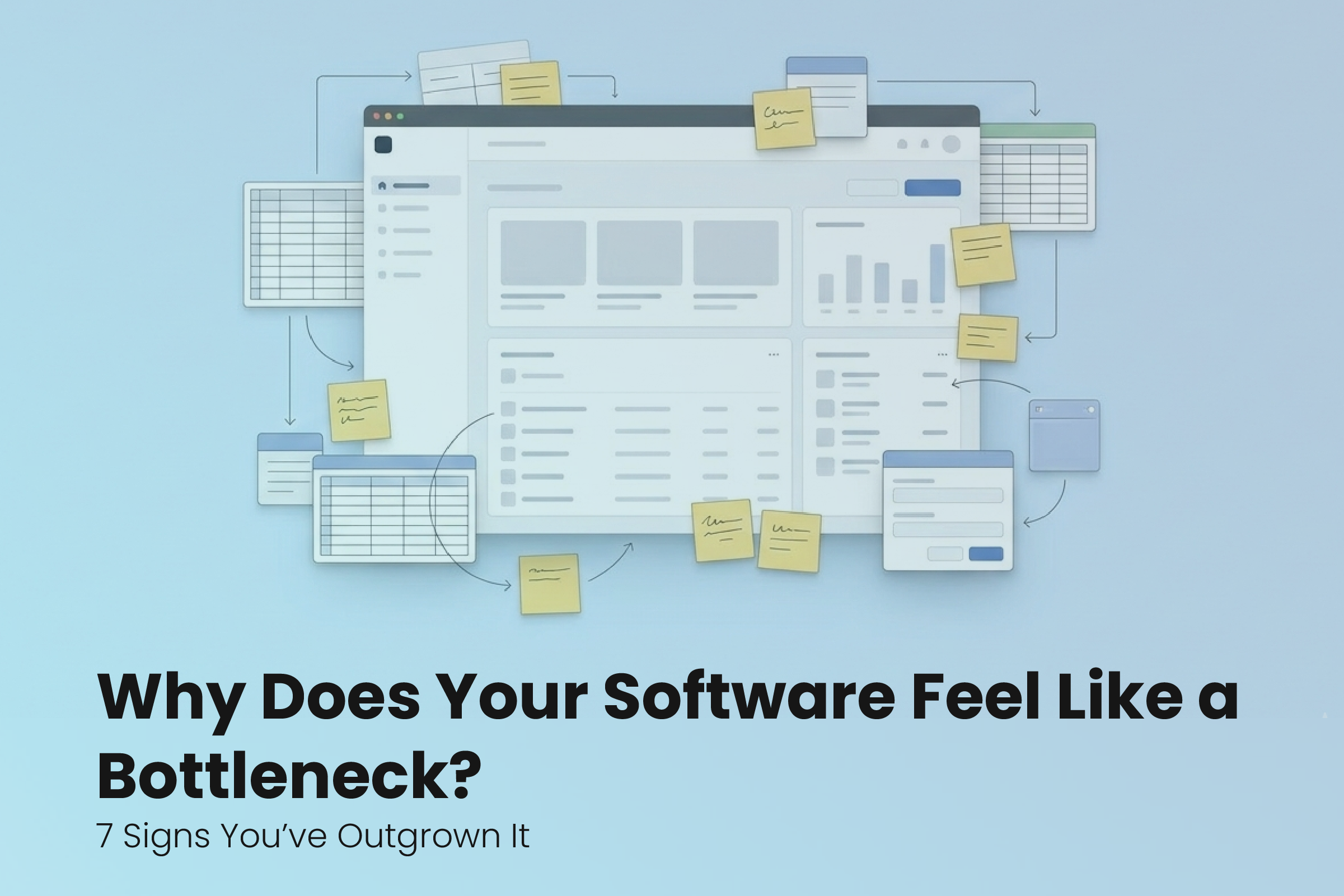
7 Signs We Found That Indicate Your Business Has Outgrown Off-the-Shelf Software

7 Signs We Found That Indicate Your Business Has Outgrown Off-the-Shelf Software

A business has outgrown off-the-shelf software when its workflows, reporting needs, and operational complexity no longer fit within generic tools. Common signs include manual data transfers between systems, reliance on spreadsheets or shadow processes, rising software costs without productivity gains, and vendor limitations blocking growth. When teams spend more time working around software than using it effectively, it signals a misalignment between technology and business needs. At this stage, custom software development becomes necessary to centralize data, automate complex processes, and support scalable growth.

Read More
What to Look for in a Custom Software Development Partner (And Red Flags to Avoid)

What to Look for in a Custom Software Development Partner (And Red Flags to Avoid)

Choosing the right custom software development partner in 2026 requires evaluating industry experience, technical expertise, development process, communication, security practices, pricing transparency, and long-term support. The best partners demonstrate proven results through case studies, follow structured Agile development processes, prioritize security and compliance, and provide scalable teams with modern tech stacks such as cloud platforms, AI/ML, microservices, and DevOps. Avoid vendors with vague portfolios, unrealistic pricing, poor communication, or weak intellectual property protections.

Read More